How Power Tool Downtime Affects Industrial Productivity
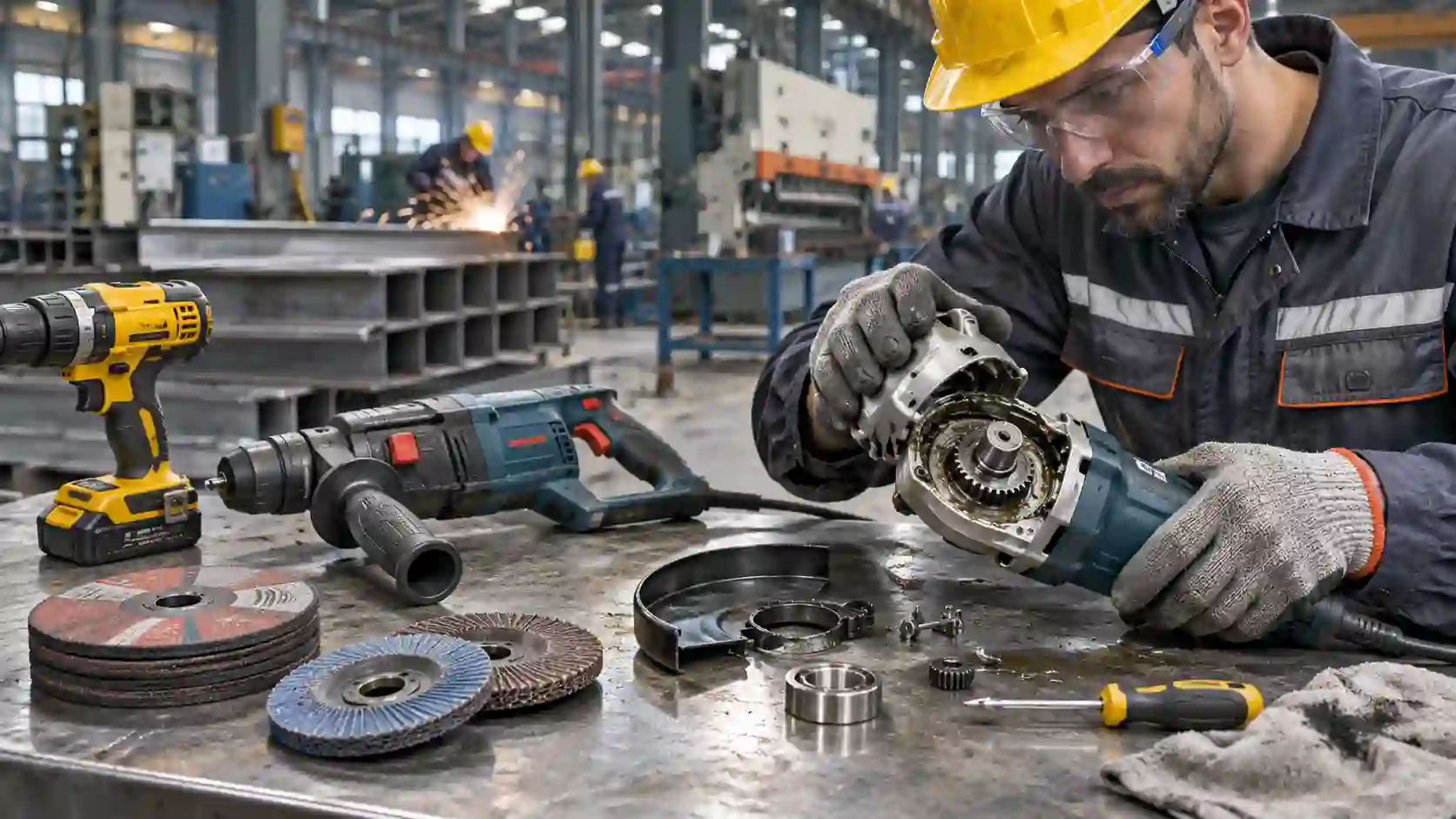
Power tools for cutting, drilling, grinding and assembly are crucial to production, and oftentimes require a constant supply in a fabrication shop. Suppose an angle grinder fails while performing a routine fabrication task. Workers have to stop working, supervisors set up the replacement, and the next job in production is delayed. When multiple operations rely on the same equipment, even the briefest of pauses can impact the entire workflow.
Power tools play an important role in maintaining industrial productivity, particularly in manufacturing units, fabrication workshops and engineering facilities. If vital equipment is not available, companies can suffer from a loss of production, wasted manpower hours, and delivery delays. The industries can keep their production going smoothly if they understand the causes of power tool downtime and are able to take action.
How Power Tool Downtime Affects Industrial Productivity
Failure of power tools may cause disruption to various manufacturing processes such as cutting, drilling, grinding, surface preparation and assembly processes. They aren't just confined to the machine in question. A breakdown can also have an impact on connected production activities, the use of the workforce and Industrial Productivity.
Reduced Production Output and Workflow Interruptions
Typical manufacturing activities are done in a sequence, with one activity relying on the completion of another. If a power tool fails, the job might not be completed until the tool is fixed or replaced.
The interruptions cause decreased production yields and impact the process. Frequent stops can cause supervisors to have a hard time keeping production standards.
Increased Labour Costs and Idle Working Hours
Workers may be given certain jobs according to the need of the production. If necessary, staff may be required to wait for replacement power tools or report on breakdowns or make alternative arrangements.
This causes idle working time, especially when the employees are unable to be reallocated to a different appropriate job.
Imagine a factory with 4 people working with the same grinding machine. Should an operation be unable to use the machine for two hours, they could be missing out on eight potential labour hours.
Overtime costs are also an added cost to businesses that have to pay overtime to catch up on production. Thus, the power tool downtime costs can extend beyond the costs of repair of the tools and can impact total labour productivity.
Material Wastage, Rework and Delivery Delays
Sometimes, the quality of in-progress work is impacted by out-of-the ordinary equipment issues. As the tool begins to indicate failure, it can begin cutting in a manner that is not uniform, the surface finish may not be even or spot-on, and the drilling may become unstable before the operator is aware of the issue.
In these circumstances, more inspection or material correction or rework may be needed. It may be necessary for the business to replace the affected material if the component cannot be recovered.
Another impact of production interruptions is the delayed dispatch, particularly when the interrupted production activity is critical to order completion. Multiple postponements may lead to problems within the process of coordination with the customer, suppliers and other production departments.
Minimising equipment failure ensures industry operates with improved process control and prevents unnecessary reworking.
How Can Industries Calculate Power Tool Downtime?
Knowing when equipment is down can enable businesses to know how often tools are broken and what production time is impacted. Do not consider breakdowns as individual events; manufacturing units should keep track of all significant breakdowns.
The following information can be captured:
- The name of the equipment, model number and assigned department.
- Monitor the amount of unplanned stoppages in a given time frame.
- Time taken from equipment failure to successful restoration.
- Determine the number of workers who rely on the equipment that is unavailable.
- Maintain information about the failure, replaced components and repair time.
- Add and show delays and affected quantities and changes in delivery dates.
A simple way to calculate lost labour-hours is:
Lost Labour-Hours = Downtime Hours × Number of Workers Affected
For instance, if a power tool breaks down for three hours and four workers can't do their assigned work, then their loss is 3 hours and the 4 workers' losses are the tasks they've been working on.
Lost Labour-Hours = 3 × 4 = 12 labour-hours.
This equates to 12 possible labour hours lost. It does not presume that it is 12 hours of entirely lost paid employment, as work might be assigned to a different activity.
Additionally, if a more comprehensive evaluation is desired, businesses can also determine equipment availability:
Equipment Availability (%) = (Scheduled Operating Time − Downtime) ÷ Scheduled Operating Time × 100
Regular downtime analysis can be beneficial for the maintenance team to identify the machine that fails regularly and prioritize corrective action.
What Causes Power Tools to Stop During Industrial Work?
This can happen because of improper operating procedures and equipment issues with power tools. In many industrial power tools applications, the selection and maintenance of the right tools is critical.
These are some of the common reasons:
- Using a tool past the recommended capacity can lead to over heating, excessive vibration and can damage the motor.
- Carbon brushes, bearings, switches and other internals.
- Incorrect use of cutting discs, drill bits or grinding wheels can cause an increase in machine resistance and affect performance.
- Unexpected failures can be caused by a build-up of dust, failure to lubricate and replace parts worn.
- Tools will not work properly if you use low voltage or damaged cable or loose electrical connections.
- Using too much force, running continuously over the prescribed time and mishandling equipment can reduce the longevity of your equipment.
Some failure is a natural part of operating a component, but others can be avoided by selecting the right equipment, training operators and performing adequate planning and maintenance.
How to Reduce Downtime with Proper Power Tool Maintenance
One of the most useful means of minimizing unplanned equipment downtime is preventive maintenance. Routine checks and good operating procedures can detect potential issues before they become serious problems.
Industries can follow these maintenance practices:
- Inspect power cords, power switches, power housings, ventilation openings and accessories prior to use. Look for signs of damage or abnormal operating conditions.
- Remove dust, metal particles & other materials that have been accumulated, following the manufacturer's cleaning procedures. Overheating can be caused by blocked ventilation openings.
- Choose suitable drill bits, cutting wheels, grinding wheels and other accessories based on the specifications of the drilling tools and the requirements of the accessories.
- Check commonly-used tools on a scheduled basis. Replace worn parts, and schedule maintenance as needed by operating conditions and manufacturer's specifications.
- Employees should be aware of proper use, limits and safety procedures when handling the train equipment. Equipment damage can be avoided by proper training.
- Maintenance requirements, recommended accessories, duty cycles, service intervals, etc. in operating Manuals.
- Recording inspections, repairs and/or replacement of equipment and any recurring problems.
These are maintenance measures to improve equipment reliability and to allow continual manufacturing.
How to Choose Reliable Power Tools for Industrial Use
Choosing appropriate equipment also plays a crucial part in decreasing power tool downtime. The tools that an industrial buyer chooses should be based on the specific use, and not just on the up-front cost.
These are the factors that procurement teams need to take into account before buying:
- Determine if the tool is to be used for drilling, grinding, cutting, polishing, fastening or other industrial use.
- Make comparisons of the power, speed, torque, capacity, etc. of the machines and equipment involved to the task to be performed.
- Review the construction, material and general design to see if the tool is appropriate for routine industrial use.
- Take into account operating hours, operating intensity, environmental conditions and equipment use frequency.
- Ensure that technical support and authorised servicing is available when needed.
- Know the warranty period, the parts covered and the conditions for the warranty.
- Ensure replacement parts and accessories are in stock and suitable for easy future maintenance.
Industrial buyers can also leverage on the services of reliable Power Tools Suppliers In India like Ultra Touch to find appropriate power tools and gain technical details prior to the procurement process. The equipment should be suitable to the current need of the site and provide practical support for maintenance and service.
Why Power Tool Availability Matters for B2B Operations
Availability of equipment is significant for B2B manufacturing operations to maintain coordination between production departments, vendors and customers. Fixed production schedules and order commitments are common in industries, and having working equipment is essential to their operations.
For businesses, it is important to keep some backup setup for the tools which are used in the critical production activity. When a machine needs servicing, having a suitable replacement machine can help workers maintain operations.
Another factor to consider is spare parts planning. Common items that are frequently needed should be obtained from reputable suppliers to prevent such delays in repair service.
Procurement groups may also keep an equipment inventory that features tool specifications, acquisition details, warranty details and equipment services. This simplifies the planning of replacements and equipment needs among departments.
Access to consistent power tools facilitates smoother manufacturing team coordination and can help businesses keep their production running smoothly.
FAQs About Power Tools and Industrial Downtime
1. What are the common reasons for power tool breakdowns in industries?
Power tools are usually the victims of overload, worn components, inappropriate accessories, maintenance and electrical supply issues. Worn equipment can also cause unexpected equipment shutdowns, if it is operated incorrectly.
2. How does power tool downtime affect industrial productivity?
Power tool downtime causes manufacturing to be interrupted, impacts production and results in unproductive working hours. It also can lead to higher rework needs and impact order completion and delivery.
3. How can preventive maintenance reduce power tool downtime?
Preventive maintenance helps detect problem parts, overheating and other potential problems before they can become an issue. Reliability of equipment is enhanced with regular cleaning, inspections, servicing, and the proper selection of accessories.
4. How can industries monitor power tool performance?
Industries can keep equipment usage records, track equipment breakdown frequency and record repair time to monitor the performance of power tools. Regular inspections and downtime reports will help identify which tools need to be maintained or replaced.
5. When should industrial power tools be replaced?
When frequent failures or deterioration in performance or excessive repairs are occurring, industrial power tools should be replaced. Another reason for replacement may be requirements for operation or safety.
6. Why is spare parts availability important for industrial power tools?
Availability of spare parts helps to minimise the delay in repairs, as the damaged or worn parts can be replaced within a short time. It also aids in maintaining production schedules in industries and in equipment maintenance.
Conclusion
Industrial operations can be impacted by power tool downtime by causing disruptions in workflow, loss of production, loss of labour hours, and missed production deadlines. These problems can be reduced by choosing equipment that is suitable for the application, applying preventive maintenance and being diligent in monitoring equipment performance.
Reliability of power tools with proper technical specifications and service support is a key factor in keeping the industrial productivity levels.
|
Ultra Touch has a variety of power tools for various industrial and professional uses. Companies seeking the right equipment can browse through the selection and contact the staff for product information and questions. The proper equipment can aid in consistent manufacturing processes and reliable operations. Contact Us Now! |