Why Demolition Hammers Are Critical in Modern Construction
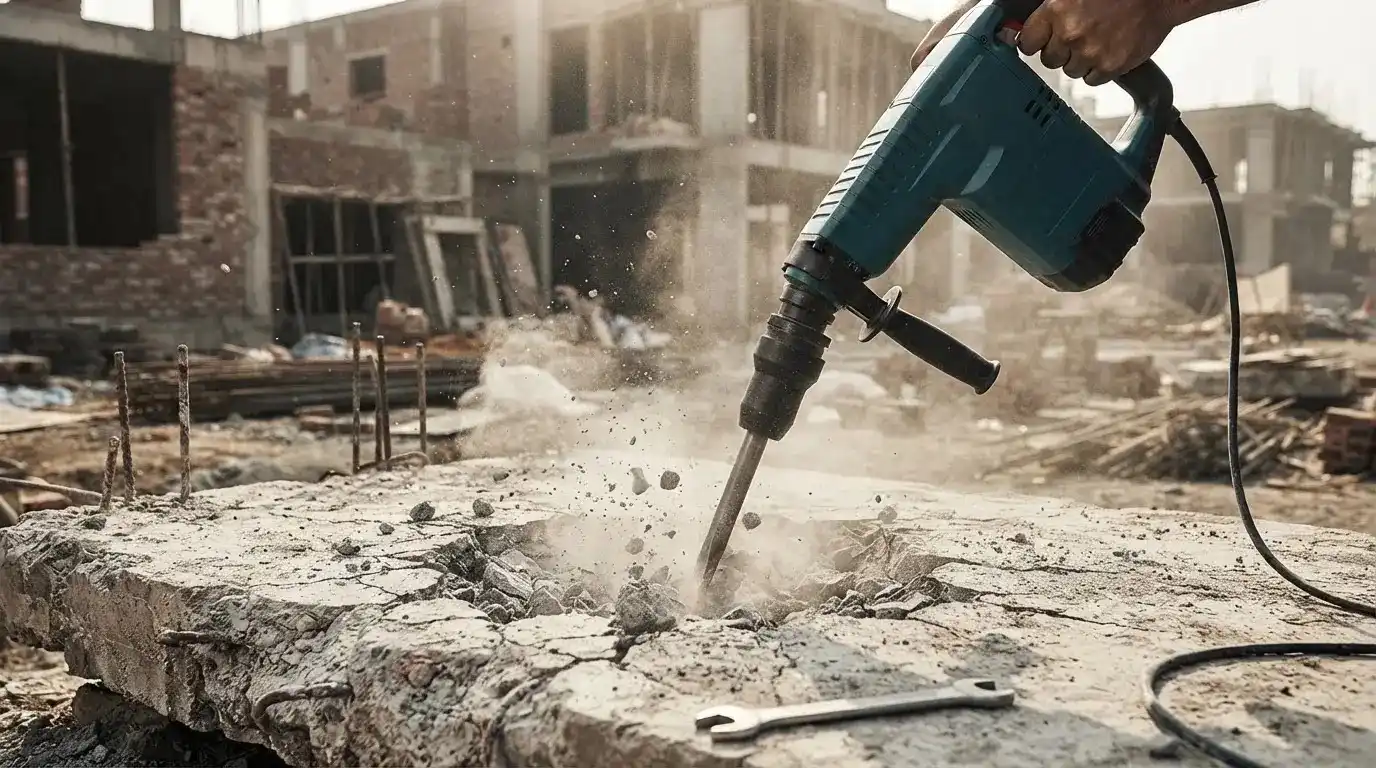
Concrete doesn't crack itself. Somebody's got to stand there with a tool heavy enough to turn a solid slab into rubble - and do it in minutes, not hours. That's the whole job of a demolition hammer. Walk onto any Indian site, Tier 1 metro or a small industrial town, and this one tool quietly decides how fast the project actually moves.
Contractors aren't sentimental about equipment. They don't care about brochures. They want something that fires up every morning, breaks concrete without choking, and doesn't die from dust or vibration after three weeks of hard use.
Timelines in India have gotten tighter. Nobody's budgeting three days for manual breaking anymore. So demolition hammers stopped being "nice to have" a while back - now they're just standard kit on any serious site, cutting a multi-day job down to a few hours.
This piece covers what these machines actually do, why contractors rely on them so heavily, and how to pick one that survives real site conditions instead of just looking good on a spec sheet. Nothing theoretical here - just what matters when the tool has to work every single day.
What Is a Demolition Hammer?
Simple definition: a heavy-impact power tool that breaks, chisels, and demolishes concrete, brick, asphalt, and stone - no manual labor required. A demolition hammer drill is a bit different though. That one blends rotary drilling with hammering, built for general-purpose work. A true demolition hammer skips the rotation entirely. It just strikes. Over and over. Pure downward force, nothing fancy.
Under the hood there's a piston-driven mechanism turning motor energy into repeated blows, sent straight through a chisel or bit. Slabs give up fast. Old flooring, masonry walls - none of it holds up the way it would against a sledgehammer and elbow grease. The operator just holds the tool steady and lets it do the rest. No skill required beyond patience and a firm grip, really.
Why Is It Important?
Ask a site supervisor why a project is behind schedule, and manual breaking work comes up more often than you'd think. Machine-driven force changes that equation - completely. It's not a small upgrade, it's the difference between a schedule that holds and one that quietly slips week after week.
- Cuts demolition time from days down to hours, even on large slabs
- Fewer injuries, less physical strain on the crew
- Impact stays consistent - not the uneven mess you get from manual swings
- Handles reinforced concrete that a sledgehammer just bounces off of
- Keeps renovation and construction deadlines realistic instead of hopeful
- Labor hours shrink, so does the cost
|
DID YOU KNOW? Some heavy-duty units hit over 3,000 blows a minute. Operators barely register the gap between strikes. |
Types and Variants
Not every job calls for the same machine - that's obvious once you've been on a few different sites. Buying heavy-duty for a small tiling job is just wasted money. Broadly, three categories:
- Light-duty: tiling, plaster removal, small chiseling jobs
- Medium-duty: general construction, wall breaking, floor removal
- Heavy-duty: continuous, high-impact work on reinforced structures
If you're shopping for demolition hammer heavy duty models specifically, you're probably dealing with large industrial demolition, road breaking, or foundation removal - jobs where anything lighter just can't keep up.
Features to Look For
Before picking a demolition hammer machine, most professionals run through the same checklist - and skipping any of these usually shows up as a problem within a few months:
- Motor that doesn't overheat under continuous use
- Anti-vibration handles - your hands will thank you after an 8-hour shift
- Tool holder that fits standard chisels and bits, nothing proprietary
- Housing tough enough for dust, grit, debris
- Weight balanced enough for one person to actually handle
- Impact energy that stays steady, shift after shift
|
FACT Anti-vibration tech in newer models cuts hand-transmitted vibration exposure significantly compared to older designs. |
Product Overview
Good Demolition Hammers pair a high-torque motor with a reinforced striking mechanism built to take a beating. Long shifts, constant dust, repeated impact - none of it should knock performance off track. Ergonomic grips and reduced-vibration housing matter more than people think; older, unbalanced tools wore operators out fast.
Here's the thing nobody puts on the spec sheet: the real test isn't day one. It's month six. That's when you find out whether the motor actually handles heat and stress, or whether it was just a good demo unit. Brochures don't survive a monsoon site with wet dust everywhere - the tool has to.
Benefits
- Projects finish faster, plain and simple
- Fewer workers needed for breaking tasks - labor cost drops
- Cleaner demolition, less accidental structural damage
- Long service life if you're using genuine parts and keeping up maintenance
- Works across concrete, brick, stone, asphalt - one tool, multiple jobs
- Safer than swinging a sledgehammer all day, no contest
Applications and Use Cases
Across construction and infrastructure work in India, demolition hammers show up everywhere - big sites, small ones, doesn't matter:
- Breaking concrete slabs and foundations
- Ripping out old tile, flooring, wall plaster
- Tearing down brick and masonry
- Breaking pavement during road repair
- Structural demolition before a big renovation
- Clearing rubble so rebuilding can actually start
|
TRIVIA Manual tools - sledgehammers, pickaxes - were the only option for decades. Machine-driven hammers only became standard on Indian sites fairly recently. |
Comparison Table: Demolition Hammer Categories at a Glance
| Category | Impact Style | Typical Use | Portability | Best Suited For |
|---|---|---|---|---|
| Light-Duty | Moderate impact | Tiling, plaster removal | High | Small renovation jobs |
| Medium-Duty | Balanced impact | Wall and floor breaking | Moderate | General construction |
| Heavy-Duty | High, continuous impact | Reinforced concrete, foundations | Lower (heavier build) | Industrial and large-scale demolition |
Expert Tips and Buying Guide
There are plenty of Demolition Hammer Manufacturers In India, and honestly, the choice gets overwhelming fast if you're not careful. Keep it practical - a few extra minutes comparing options now saves a lot of headaches on-site later:
- Match impact energy and blow rate to what you're actually breaking - don't overspend on power you won't use
- Check the tool holder fits chisels and bits you already own
- Go with brands that stock genuine spare parts and actually answer the phone for support
- Talk to demolition hammer dealers in India directly - ask for a demo before you buy anything
- Nail down warranty terms and service turnaround up front
- Stick with established Demolition Hammer Suppliers in India for stock you can count on and delivery that doesn't slip
- Maintenance cost matters more long-term than the upfront price tag - don't ignore it
Ultra Touch
Ultra Touch was founded in 1995, and is one of India's best manufacturers, suppliers, dealers and wholesalers of heavy-duty power tools. The company offers the highest quality and reliable power tools supported by a robust pan-India distribution network. Their tools are manufactured to perform in rugged industrial and professional conditions – designed to be robust, accurate and dependable. Ultra Touch manufactures ergonomic tools with a center of gravity positioned strategically and heat-resistant grips to keep the tools from becoming too hot. High-grade parts, along with well-balanced motors, enable the tools to cut, grind, drill and finish materials consistently without tiring the operator out.
FAQs
1. What's the difference between a demolition hammer and a demolition hammer drill?
Ans: A demolition hammer only strikes — no rotation, just pure downward force for breaking concrete and masonry fast. A demolition hammer drill blends rotary drilling with hammering action, built for general-purpose work like drilling holes plus light breaking. If your job is pure demolition, skip the drill and go straight for the hammer.
2. How do I know if I need a heavy-duty demolition hammer?
Ans: If you're breaking reinforced concrete, foundations, or handling large-scale industrial demolition, lighter models just won't cut it — literally. Heavy-duty units are built for continuous, high-impact work without overheating or losing power halfway through the job. For smaller tasks like tiling or plaster removal, though, a heavy-duty machine is overkill and unnecessary expense.
3. What features actually matter when buying a demolition hammer machine?
Ans: Motor stability under continuous use, anti-vibration handles, and a tool holder that fits standard chisels top the list. Don't ignore housing quality either — dust and debris wreck cheap builds fast. Balanced weight matters too; a machine that's exhausting to hold defeats the purpose. Spec sheets look good on paper, but these are the things that hold up on-site.
4. How long do demolition hammers typically last with regular use?
Ans: Honestly, it depends more on maintenance than the brand name on the box. Genuine spare parts, regular servicing, and not skipping basic upkeep can stretch a good unit's life considerably. Cheap builds or ignored maintenance schedules cut that lifespan short fast. Ask about after-sales support before buying — it matters more than most people realize upfront.
5. Are demolition hammers safe for regular workers to operate, or do they need special training?
Ans: Basic operation isn't complicated — position the tool, apply steady pressure, let the mechanism do the work. That said, proper handling training still matters, especially around vibration exposure and posture during long shifts. Anti-vibration handles help reduce fatigue-related risk. Most sites run a quick orientation before letting anyone operate one solo.
6. Where can I find reliable demolition hammer dealers or suppliers in India?
Ans: Look for established suppliers with consistent stock, genuine spare parts, and dependable delivery timelines — not just the lowest quote. Ask for a hands-on demonstration before committing, and confirm warranty terms upfront. Reliable dealers usually offer after-sales support too, which matters far more once the machine's actually out on-site working.
Conclusion
Speed and dependability run modern construction - and demolition hammers sit right in the middle of both. One wall or an entire industrial floor, it doesn't matter. The right machine turns a brutal manual job into something controlled and quick. Pick based on your actual project scale, not just what looks impressive, and it pays off on every job after this one. Construction in India isn't slowing down, and neither should the equipment that keeps it moving.
| Looking for dependable demolition hammers built for real site conditions? Contact Us Now and equip your team with reliable tools for faster, safer demolition work. |