Hammer Drill vs Rotary Hammer: Which Should You Buy?
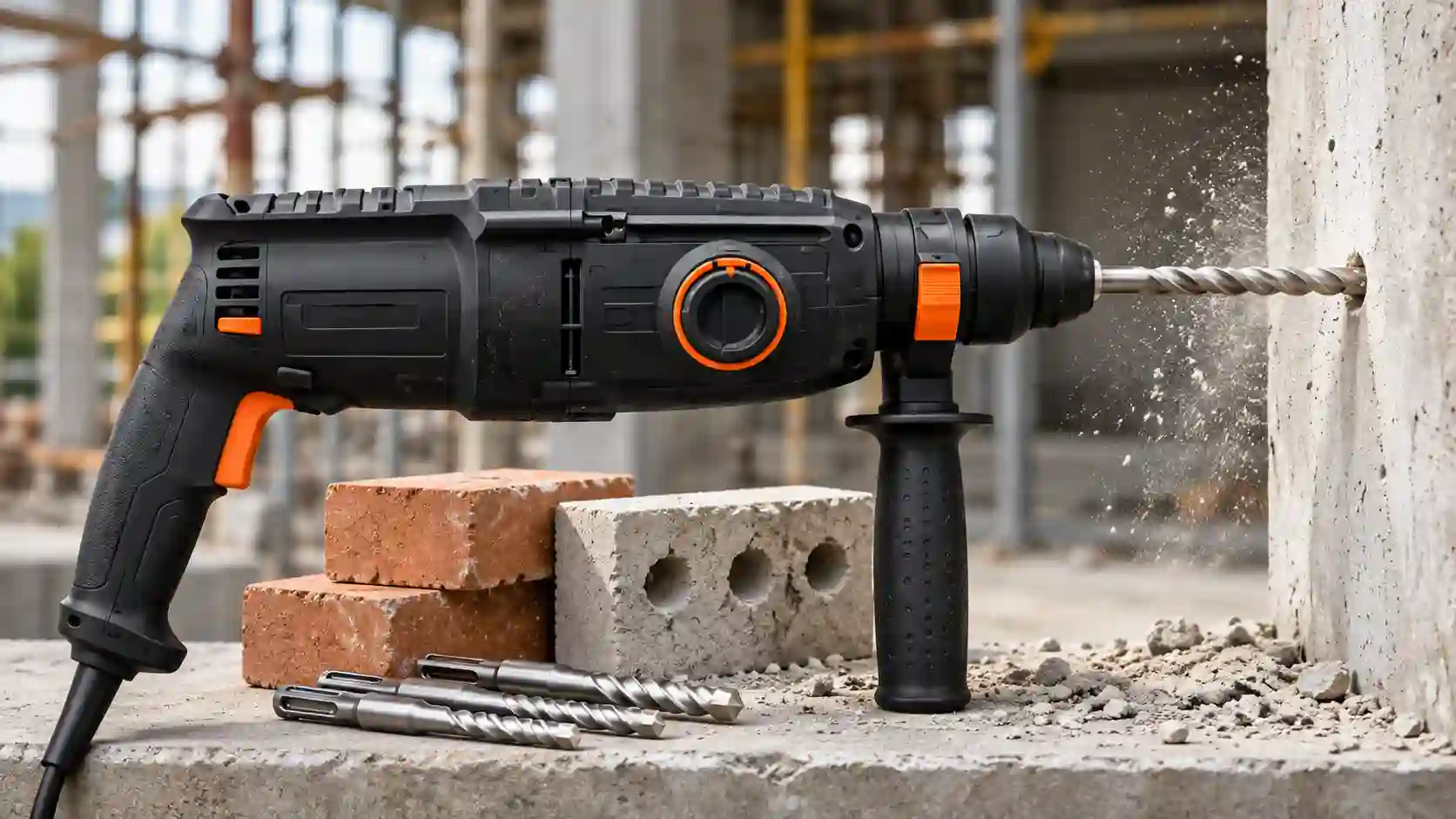
Consider the case of a contractor who is involved in a construction task that needs the creation of holes in brick walls and concrete surfaces. While a conventional drilling machine might do for small installations, drilling frequently in hard concrete surfaces requires machines with high impact force. Buying a wrong machine could mean that your work would take more time and also put unnecessary strain on the operator. This is the reason why it is essential to understand the difference between hammer drill vs rotary hammer before buying any of them. While both machines perform rotation and hammering functions, they are meant for different purposes. Whether you need an industrial hammer drill for masonry works or rotary hammer for concrete works, knowing their working process would help you make the right choice.
What Is a Hammer Drill and How Does It Work?
A Hammer Drill Machine is a type of power tool used to make holes in different materials, including wood, metal, brick, and masonry. In contrast to the ordinary drill machine, this one includes both rotary motion and fast hammering motion. The extra hammering motion makes it possible to drill the hole in harder material without any significant manual effort applied.
The hammering motion is usually produced by using two toothed wheels located in the drill machine. With the switch turned on to hammering mode, the motion of the two wheels produces the front-back movement. At the same time, the motor of the drill machine makes rotary motion of the drill bit, which allows it to drill the hole.
Common hammer drills uses provide a good opportunity to understand when it is better to use such equipment. The hammer drill machines are widely used by contractors and maintenance people to install wall plugs, mount brackets, fit electrical accessories, drill small holes in brick walls, etc.
For projects that include occasional drilling of masonry, hammer drill machines can be useful. But their application for concrete and other hard materials depends on the capacity of the machine, drill bit, etc.
What Is a Rotary Hammer and How Does It Work?
The design of a rotary hammer drill enables users to work with materials requiring powerful impact forces. They utilize the pneumatic hammering process, which ensures that blows produced by a rotor are stronger than those generated by the mechanical percussion system of conventional hammer drills.
The rotary hammer working principle uses an inner assembly consisting of the piston and striker components. While operating, the piston moves within the cylinder thus creating air pressure. The air pressure pushes the striker forward and transmits impacts to the drilling bit while the motor rotates.
Among the distinguishing characteristics of many rotary hammers is their SDS compatible bits. SDS attachments can be quickly put and removed. Besides, some of these machines have various functions of operation depending on the model. Examples include drilling, hammer drilling and chiselling. Rotary hammers are widely applied on building sites, renovation works, installations at buildings and industrial repairs due to their strong impact force.
Hammer Drill vs Rotary Hammer: Key Differences
However, in comparison with each other, the major distinctions will be related to their impact and force delivery capability. Both machines will be able to drill into masonry; however, performance of both devices depends on the hardness of the material, diameter, and rate of holes.
The subsequent hammer drill comparison provides the major distinctions that are required to take into account by industrial buyers and contractors.
| Comparison Factor | Hammer Drill | Rotary Hammer |
|---|---|---|
| Working Mechanism | Mechanical percussion using toothed discs | Pneumatic piston and striker mechanism |
| Impact Action | Relatively lighter impact | Stronger impact force |
| Drilling Material | Brick, blocks and light masonry | Concrete, hard masonry and demanding surfaces |
| Concrete Applications | Smaller and occasional holes, subject to specifications | Repeated and larger concrete drilling |
| Accessories | Standard drill bits and compatible chuck accessories | SDS-Plus or SDS-Max accessories, depending on model |
| Machine Weight | Generally lighter and compact | Usually heavier due to its internal mechanism |
| Operating Modes | Drilling and hammer drilling | Drilling, hammer drilling and sometimes chiselling |
| Typical Applications | Installation, repair and general masonry work | Construction, renovation and industrial drilling |
| Purchase Considerations | Motor power, speed, chuck and drilling capacity | Impact energy, drilling diameter, SDS system and operating modes |
It can be seen from the comparison that one machine cannot replace the other in all situations. For example, hammer drills can be used for lighter tasks, while the rotary hammers are more appropriate when impact performance is needed.
Another factor to think about when buying is how often the machine will be used. Buying a more powerful machine for light tasks and choosing a less powerful machine for heavy tasks can both be problematic.
Which Tool Performs Better for Different Materials?
The efficiency of a drilling machine depends on the hardness of the material, the diameter of the hole needed, and the frequency of drilling operations. The use of appropriate industrial drilling tools will allow contractors to finish their work without straining the machinery.
Brick and Light Masonry Applications
In case of small holes in brick walls, concrete blocks and related materials, a standard hammer drill for masonry might be a good option. It is often employed in fixing electrical fixtures, wall plugs, shelves, brackets and similar accessories.
Its relatively small size makes it easier to manage while doing installation and maintenance tasks. For contractors who sometimes have to deal with masonry, this machine will do the job effectively without having to employ a bigger rotary hammer.
It is important for buyers to make sure that the manufacturer's recommendations regarding drilling capacity are observed. The quality of brick, thickness of the wall, drill bit and the size of the hole needed will affect the end result.
Concrete and Heavy-Duty Drilling
If the task at hand entails drilling on a frequent basis through hard concrete, the rotary hammer for concrete will prove to be more appropriate for this task due to its ability to provide much stronger impact thanks to its pneumatic system.
The rotary hammer is applied by construction contractors in drilling anchor holes, fixing structures, pipeline installation and renovations. It will also come handy where multiple holes of similar or bigger diameter have to be made.
The heavy duty drilling machine should be picked depending on the nature of the material, drilling diameter, impact energy and operating hours. For reinforced concrete, the buyer should make sure that the machine selected is suitable for his/her purposes.
What Should Industrial Buyers Check Before Purchasing?
In choosing an industrial hammer drill for professional use, there is much more to it than the price and motor capacity of the machine. The key elements that should be taken into consideration in a hammer drill buying guide are technical efficiency, ease of use, accessories, and maintenance issues.
Motor Power, Impact Energy and Drilling Capacity
One of the first characteristics that people pay attention to while choosing a drill is motor power. This is the electrical energy consumption of the device. However, more watts do not always mean a better quality of drilling.
While analyzing the Hammer Drill Specifications, the buyer needs to take into consideration such features as no-load speed, impact frequency, suggested drilling diameter and the materials that the drill was made to work with.
As to rotary hammers, it is worth looking at the characteristic named "rotary hammer impact energy." It is usually expressed in joules. The impact energy is helpful in difficult drilling. However, this feature has to be taken into account together with drilling capacity, design and conditions of work.
For instance, an independent worker who drills small holes in order to place anchors does not need the same impact performance as a crew that works on a construction site with bigger concrete holes. The comparison of the model specifications and the amount of work will help save money.
It is important to pay attention to the maximum recommended diameter of drilling in concrete, masonry, etc.
Tool Compatibility, Comfort and Maintenance
The compatibility of drill accessories with the machine should be considered as well before buying the drilling device. The buyer needs to make sure that they have the necessary hammer drill accessories such as drill bits, chucks and other accessories needed for their operations.
Standard keyed and keyless chucks are commonly used in traditional hammer drills while SDS rotary hammer will require the right SDS fitting accessories. There is both SDS-Plus and SDS-Max and they are not interchangeable so it needs to be clarified what is required in a specific application.
Besides accessories, weight of the machine, grips and vibration levels will also determine how comfortable it will be to work with the machine. This is especially relevant when the technicians use the drill machine for long periods of time or conduct overhead drilling.
Hammer Drill or Rotary Hammer: Which Should You Buy?
Ultimately, the choice between a hammer drill vs rotary hammer comes down to the nature of the jobs you do. There isn't any machine which can satisfy all types of drilling jobs, and hence, you need to know what you really need before buying one.
An ordinary hammer drill would be a good choice for contractors, electricians, and maintenance staff who drill mostly through brick walls, blocks and light masonry. It is sufficient for small drilling and installation jobs and occasional repair jobs.
When you decide to buy a Professional Hammer Drill, then you should compare the motor power, impact system, drilling capacity, accessories and service of the machine. You should also take into consideration the number of machines needed, hours of operation, and kinds of jobs.
UltraTouch offers both for industrial uses.
Conclusion
The decision of choosing between a hammer drill and a rotary hammer is easy with proper knowledge about the material to be used and the size and frequency of drilling required. The usual hammer drill is adequate for masonry, small hole sizes and installation purposes. Whereas the rotary hammer is better suited for continuous drilling in concrete, large holes and construction purposes.
Comparison of Hammer drill manufacturers in India and hammer drill suppliers in India will involve looking beyond the price factor. Technical specifications, drilling capacity, available accessories, service options and parts availability are as important when opting for tools for professional application.
UltraTouch offers drilling tools for individuals looking for appropriate tools for construction, maintenance and industrial application. Customers can view the different machine choices before making an inquiry.
FAQs About Hammer Drills and Rotary Hammers
1. Can a hammer drill be used for drilling concrete?
Yes, a hammer drill can indeed be used for making small-sized holes in concrete provided that such equipment is designed to do the task. But for heavy-duty applications, larger holes and tough surfaces of concrete, a rotary hammer would be better.
2. What is the main difference between a hammer drill and a rotary hammer?
The major distinction between the two tools lies in the way of how impact is delivered. While a typical hammer drill employs a percussion technique using toothed discs, a rotary hammer features a pneumatic piston-and-striker system.
3. Which machine is better for regular construction work?
This all depends on the type of construction project that is being undertaken. For small masonry and installation projects, a hammer drill is recommended, but if you need to do some concrete drilling, then a rotary hammer drill is more suitable.
4. Can a rotary hammer be used as a regular drill?
Yes, rotary hammers have some models with a rotation only mode and can be used in drilling. Nonetheless, one must take note of the modes of operation and accessories to use the machine when working with materials like wood or metal.
5. What is the difference between SDS-Plus and SDS-Max rotary hammers?
Use of SDS-Plus is made in case of light to medium drilling tasks, whereas SDS-Max can be applied in case of bigger machines that drill or chisel. Choosing the suitable tool is determined by the size of drilling and impact power.
6. What factors affect the price of a hammer drill machine?
The cost of a hammer drill machine is based on the motor strength, impact efficiency, drilling capability, construction quality, brand name and accessories. Users are advised to consider the technical specifications, warranty coverage and maintenance services before purchasing.